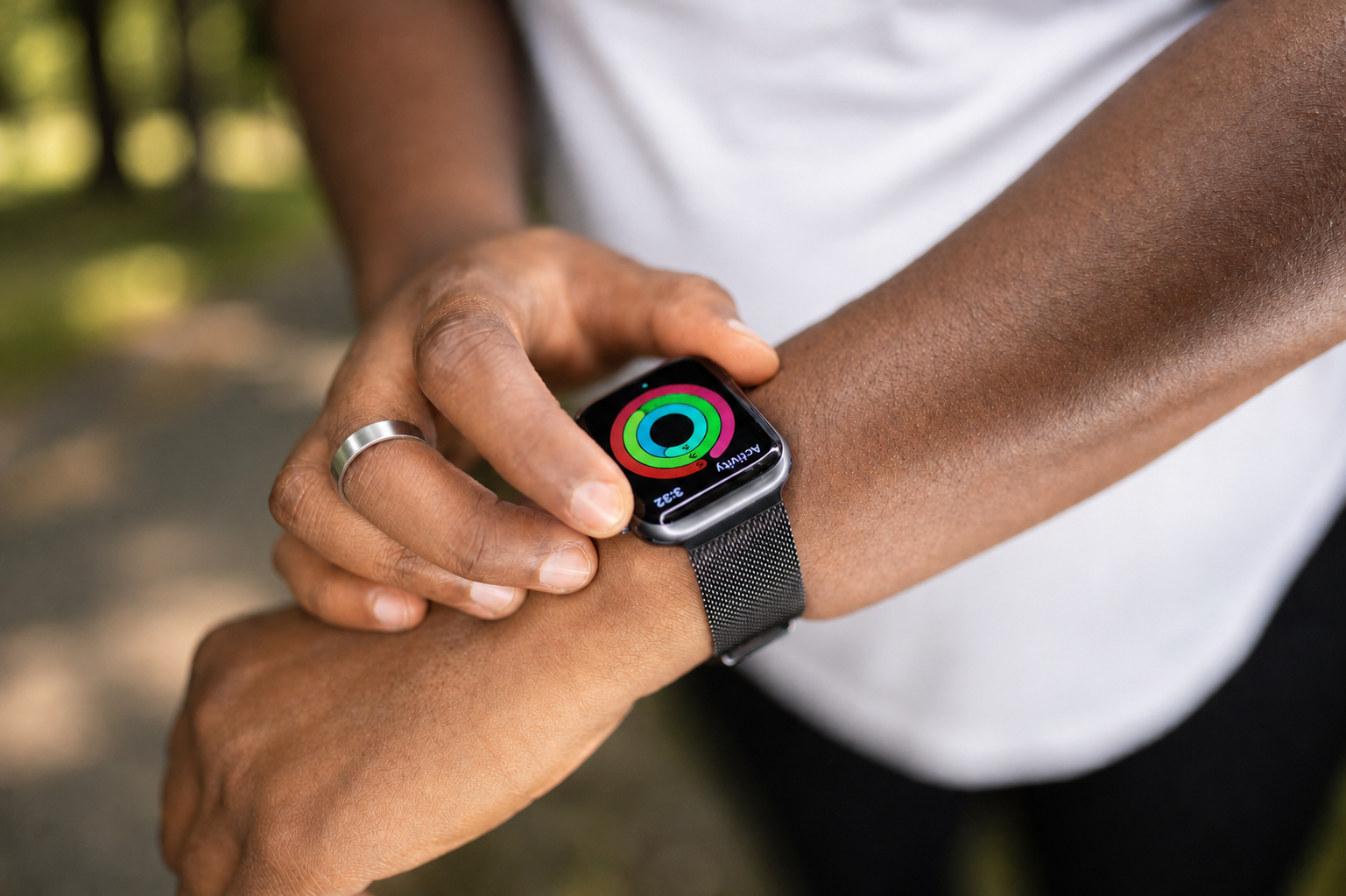
We get pitched on wearables constantly - so why have we passed on most? We're not waiting for a better WHOOP. We're waiting for the company that makes the comparison irrelevant - measuring something different, for a population that's been ignored, at the moment it can actually change something.
At Cade, we back category-defining companies at the earliest stage across health tech, consumer tech, and connected hardware. We are comfortable underwriting hardware complexity, and we are drawn to consumer businesses that earn a direct relationship with users, generate proprietary insight, and compound into durable data advantages. Wearables should be one of the clearest expressions of that thesis.
We get pitched them constantly. We’ve passed on most. Not because we’re skeptical of the category (we’re not), but because the companies we’ve seen haven’t yet cleared the bar on the things that matter most to us: consumer adoption conviction, commercialization timeline, and differentiation beyond the big players that have already won a sizable chunk of the space. All three of these attributes must be true at the same time.
This is our attempt to be transparent about what we’re seeing, why it hasn’t been enough yet, and what we’re waiting for.
THE MOMENT THE CATEGORY IS HAVING
46% of Americans now own a wearable, up from 13% in 2015. 83% wear it five or more days a week. 47% have owned one for three-plus years. This is consumer staple behavior, not gadget behavior. Retention is stronger than the “drawer rate” narrative suggests, as 48% have never switched devices, and when people do upgrade, 41% are chasing features and 32% want better app integrations. Apple dominates at 63% ownership, but Oura punches well above its 6% share in cultural relevance and investor attention.
Rock Health, 2025 Consumer Adoption of Digital Health Survey (N=8,000; n=3,662 wearable owners)
The wearable category has a data problem. Consumers can tell you their HRV, their sleep stages, their readiness score, yet still have no idea what to do with any of it. The incumbents have built beautiful dashboards, but no one has built the decision layer.
The market signal is loud: Oura filed to IPO, WHOOP raised a mega round, Garmin and Samsung are leaning hard into health coaching. WHOOP added in-app telehealth; Oura tapped Counsel Health for AI-led primary care. And now Google has entered directly with the Fitbit Air: a screenless, WHOOP-like device at $99 with no mandatory subscription, backed by Google's manufacturing and marketing scale. The Fitbit app is dead; Google Health is live, with a Gemini-powered coaching layer fusing hardware, software, and AI subscription into a single platform aimed squarely at Apple and WHOOP. YC is back funding wearable hardware. The cycle is running again.
Our view is that when incumbents consolidate at the top, it's not a sign the category is closed, but rather a sign it's ripe. The largest players have won on scale, but they have not solved for the consumer who is drowning in data and still asking, “What should I actually do?” The opportunity is to close that feedback loop, translating continuous inputs into useful action. And with development timelines compressing, even in hardware, startups can now move at a pace that would have been impossible five years ago.
TechCrunch; DC Rainmaker; Pasquale Pillitteri (LinkedIn); public reporting
WHY WE KEEP PASSING
1| Retention is the category's hard problem, and the incumbents have already solved it.
Abandonment is the norm outside the leaders. Roughly 30% of users quit their tracker within six months, and while about one in ten American adults owns an activity tracker, half no longer use it, citing lack of perceived usefulness and boredom. The users who stick around skew heavily toward the incumbents. Oura and WHOOP cracked retention through subscription lock-in and community, not product magic, and that moat now compounds: years of longitudinal data and entrenched subscriber bases most consumer health companies would trade everything for. Google has since dropped the price floor on the category, so what was premium is becoming a platform feature.
That leaves any general-wellness pitch having to clear two bars at once: "why not just use Oura or WHOOP?" and "why can't Oura, WHOOP, or Google build this as a feature?" Most can't clear either. Doing so convincingly requires something genuinely novel in form factor or community, enough to build a proprietary dataset with gated access, or a frontier product good enough to beat the incumbents' switching costs.
2| Switching is feature-driven, not loyalty-driven.
When wearable users do switch, it's almost entirely driven by two things: better features and better device and app integrations. That tells you something important: the hardware is just the entry point, but the actual product is the software layer and ecosystem connectivity around it. Users who leave for features are a churn risk for anyone not continuously shipping. Users who leave for integrations are telling you the platform is the moat, not the device. Only companies that own the software layer deeply enough hold them long-term.
3| More data is not automatically better insight.
Most pitches solve for data volume: better PPG, longer battery, more metrics, prettier dashboard. That's the wrong problem. The real question is whether the data is meaningful because it's continuous, and not just continuous for its own sake. Take recovery as an example: If you want to understand how someone is progressing through a training block or bouncing back from an injury, 24-hour heart rate and sleep scores only get you so far. You need to know how they're moving during the relevant moment: whether the right muscles are activating, whether they're compensating, whether range of motion is improving week over week. The value isn't in always-on data; it's in the right data, captured at the right moment, in the right context. Most devices aren't built around that distinction, and instead built around coverage. The incumbents have optimized for breadth, but we see the white space as specificity.
New England Journal of Medicine; npj Digital Medicine (Nature)
Our broader take is: the incumbents didn't win by doing everything; they won by owning something. Oura owns sleep. WHOOP owns HRV. In many ways, the metric is the product identity, and it's what drives the initial hook, the daily habit, and the retention that follows. The next opportunity in wearables isn't another general wellness device. It's the company that plants a flag in a category nobody has claimed yet and builds the definitive dataset around it.
OPPORTUNITY AREAS WE ARE WATCHING AT CADE
1| MSK and clinical rehab
The entire consumer wearable market has been built around passive, ambient tracking: steps, sleep, HRV. That works for wellness, but it doesn't work for recovery. Rehab clinicians need muscle activation data, flexible sensor placement, exercise-specific motion capture - composite signals showing how the body performs during a rep, not a 24-hour dashboard. Stanford's Mobilize Center found that wearables that successfully integrate into clinical care share one trait: they sit inside an integrated care process with a closed feedback loop to the treating clinician, rather than standing alone. The ideal product guides a patient through a rehab exercise at home, tracks whether the right muscles are firing, flags compensation patterns, and delivers clinician-actionable data. Different moat, different buyer, different retention dynamic; the patient has a clinical reason to keep wearing it.
Nature (Stanford Mobilize Center)
2| Women's health
76 of 86 commonly used drugs show sex-based pharmacokinetic differences, and women experience adverse drug reactions at nearly twice the rate of men - a bias inherited directly by consumer device algorithms, whose HRV, recovery, and sleep norms are largely derived from male data. But a woman's body runs on a hormonal cycle that shifts nearly every relevant biomarker across 28 days, so the device telling her she's "recovered" may just be reading her cycle. Whole categories - fertility, perimenopause, menopause, female-skewed autoimmune conditions - remain underserved, and Oura's young, female base shows the demand is already there. The strongest builds here won't be wearables so much as foundational research infrastructure, and the longitudinal datasets are the moat.
Nature (sex bias in clinical research); Rock Health
3| Respiratory and nervous system regulation
Every other wearable metric is read-only; breath is the one autonomic signal you can consciously intervene on, which makes it a therapeutic lever, not just a measurement. Heart rate tells you what happened, breath tells you what's happening and gives you something to pull. The thesis inverts passive tracking: detect the state shift in real time - stress onset, attention drop, recovery stall - then guide the correction before the window closes. A device that does something useful in the moment, repeatedly, is much harder to put in a drawer than one that updates a sleep score overnight.
4| Metabolic health beyond glucose
CGM began as a diabetic device and is moving into performance and longevity, but glucose is just one metabolite - and continuous glucose still captures meaningful glycaemic physiology even in non-diabetics. The broader thesis is a continuous, noninvasive metabolic panel: lactate for athletic performance, ketones for metabolic health, cortisol for stress. The sensor science is advancing, but the consumer product hasn't been built. The CGM playbook (clinical origin to DTC expansion) has already been proven once.
Nature Communications
WHAT WE'RE ACTUALLY LOOKING FOR
1| A sensor or biomarker that the incumbents' datasets are entirely irrelevant to.
This means the data moat is original, not derivative.
2| A population that has been chronically undermeasured.
The companies that build this first will own a longitudinal dataset nobody else can buy.
3| Real-time intervention, not retrospective reporting.
We want products that change something versus “just describe it.”
4| DTC fundamentals that hold past 90 days.
We are looking for retention curves, LTV, evidence of sustained behavior change, and a team that can credibly articulate how they get there before the product is live.
5| A software business built on top of the hardware.
Here at Cade, we believe the device is customer acquisition, but the data and coaching layer is the long-term asset.
6| A founder with genuine hardware scars.
We are looking for someone who has shipped physical product and deeply understands the engagement dynamics that separate a device people keep wearing from one that ends up in a drawer.
7| A deep understanding of the customer and demand signals.
The health tech flywheel only works if users stay on the device - which makes consumer adoption, retention, and daily engagement the central underwriting question at this stage. Even pre-launch, we’re looking for evidence of deep consumer intuition: a founder who has lived the problem, mapped the behavior change required, and has a credible theory for how they earn the habit.
8| A commercialization timeline within 12 months.
This is specific to our thesis; for us, compelling vision isn't enough to outweigh a long, regulatory-burdened runway with significant R&D in the pipeline. We need to see a credible path to product in market.
LOOKING AHEAD
The wearable opportunity isn't dead. We're not waiting for a better WHOOP; we're waiting for the company that makes the WHOOP comparison irrelevant because it's measuring something different, for a population that's been ignored, at the moment it can actually change something.
That's a harder product to build. It's also a much harder product to copy. And the team building it will need to show us not just that the science works, but that they understand the consumer well enough to make it stick.
And if you're building it, we want to talk.